

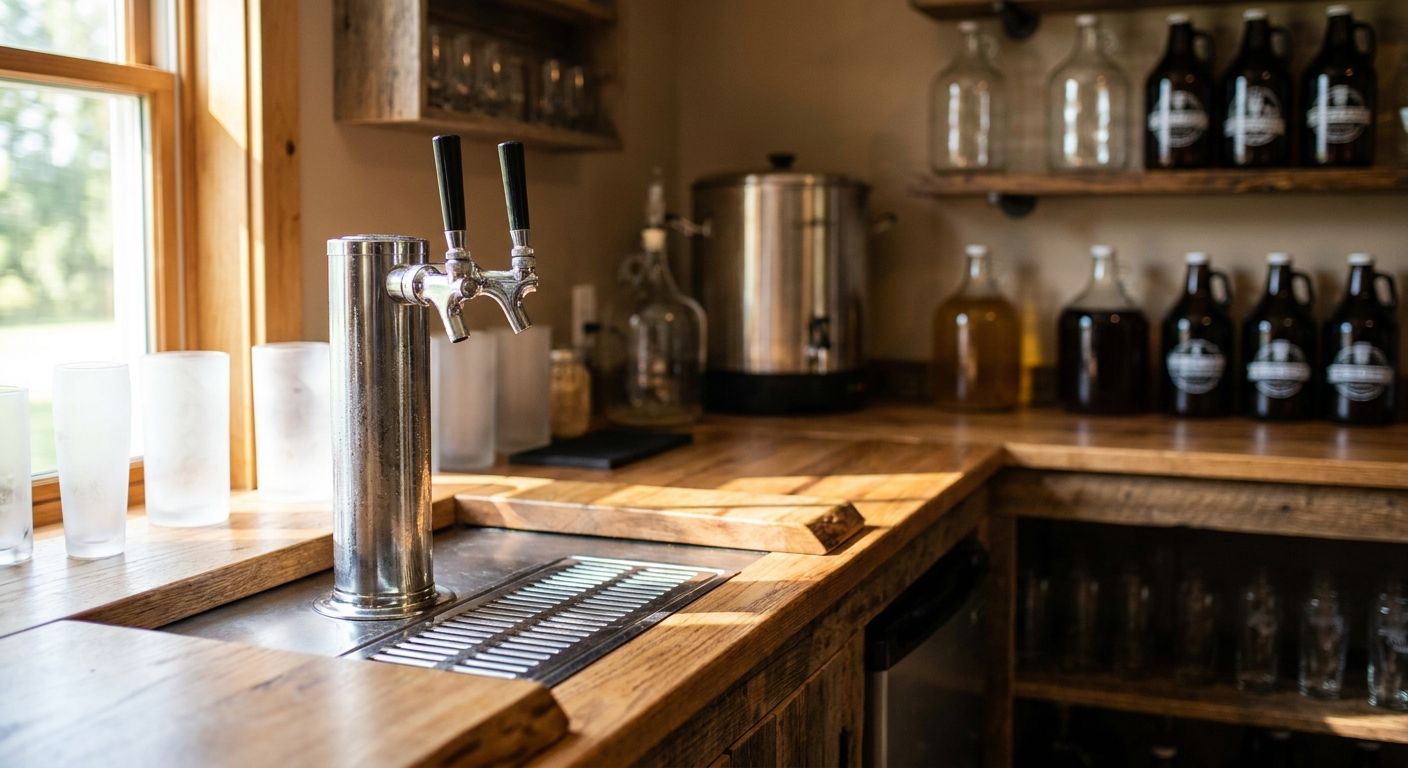
The best kegerator for home brewing depends on your batch size, tap count, and how much floor space you can spare — a chest freezer conversion and a countertop single-tap unit solve completely different problems.
- The best kegerator for home brewing depends on batch size and tap count, not brand name.
- A single-tap kegerator running one 5-gallon corny keg fits most standard batches. Best Overall.
- Keezers built from chest freezers win on capacity for brewers running several 5-gallon batches at once.
- Mr. Beer's small-batch kits are built around bottle conditioning, not kegging, so no kegerator is required.
- Skip kegging entirely if you brew small batches and bottle-condition with a system like the 740ml deluxe bottling system.
Why This Matters
Searching for the best kegerator for home brewing usually means one thing: you're tired of bottling. Bottling works, but it adds a conditioning wait and a sink full of glass to clean after every batch.
A kegerator skips the bottle step entirely. You rack finished beer straight into a keg, force-carbonate it with CO2, and pour from a tap within days instead of weeks. That said, not every homebrew workflow is built around kegging — Mr. Beer's complete beer making kit is built around bottle conditioning, not kegging, and that's a legitimate path that skips a compressor and a CO2 tank altogether.
If you're set on kegging, the setup that matches your batch size and space in 2026 matters more than the sticker on the box. A countertop mini kegerator and a dual-tap keezer solve different problems, and neither one is universally "best."
How to Think About Kegerator Setups
Before ranking anything, match the setup to three fixed numbers: gallons brewed per batch, beers wanted on tap at once, and clearance available for a compressor. Every category below is ranked against those three factors.
Standard homebrew batches meant for kegging run on 5-gallon corny kegs — the same ball-lock kegs used across most single-tap and dual-tap kegerators sold in 2026. That number matters because a kegerator sized smaller wastes capacity, and one sized bigger won't clear a doorway or a closet.
Mini Countertop Kegerator — Best for Small Spaces
A mini kegerator is built to hold a single mini keg (5 liters) or a shortened corny keg, with one tap on top and no room for a second line. It's the smallest footprint on this list and the easiest to tuck onto a counter or under a bar cart.
The tradeoff is capacity: one keg means one beer on tap, and you're refilling more often than with a full-size unit. For anyone working out how to store homebrew equipment in small spaces, this is the setup that asks the least of your square footage. Best for Small Spaces.
Single-Tap Kegerator — Best Overall
A single-tap kegerator runs one full-size 5-gallon corny keg, one CO2 tank (commonly 5 lb), and one tap. It's the configuration most homebrew kegerators ship as, and it matches the most common homebrew batch size without extra plumbing.
This is the setup most 5-gallon batch brewers land on first, because it needs no manifold, no second regulator, and no extra keg to store between brews. Best Overall.
Dual-Tap Kegerator — Best for Brewers Who Want More Taps
A dual-tap kegerator holds two corny kegs on a shared CO2 manifold with two separate lines and faucets. It earns its keep when you're running two batches at once or want to serve two styles side by side without swapping kegs.
The manifold and second regulator add a step to setup, and the cabinet has to clear two kegs instead of one. Best for Brewers Who Want More Taps.
Kegerator Conversion Kit (Mini-Fridge) — Best Value
A conversion kit adds a tower, tap, and CO2 line to a mini-fridge you already own instead of buying a dedicated kegerator cabinet. You skip the cost of a new compressor and still end up with a full-size 5-gallon corny keg and one working tap.
The fridge has to have the interior clearance for a keg and a CO2 tank, which rules out some smaller units. Best Value.
Keezer (Chest Freezer Conversion) — Best for Bigger Batches
A keezer starts as a chest freezer, gets a wooden collar on top, and ends up holding three to four corny kegs with two to four taps. It's the setup with the most capacity on this list by a wide margin.
Brewers running several 5-gallon batches at once, or serving multiple styles at a time, outgrow single-tap units and land here. Best for Bigger Batches.
Setup Comparison
| Setup | Keg capacity | Taps | Best for |
|---|---|---|---|
| Mini Countertop Kegerator | 1 mini keg (5 L) or 1 short corny keg | 1 | Small Spaces |
| Single-Tap Kegerator | 1 corny keg (5 gal) | 1 | Overall |
| Dual-Tap Kegerator | 2 corny kegs (5 gal each) | 2 | More Taps |
| Mini-Fridge Conversion Kit | 1 corny keg (5 gal) | 1 | Value |
| Keezer (Chest Freezer) | 3–4 corny kegs (5 gal each) | 2–4 | Bigger Batches |
The pattern across every row: capacity and tap count move together, and space requirements scale right alongside them. Pick the row that matches your actual batch count, not the row that looks impressive in a garage.
Where to Start Sourcing Parts
A few rules keep the shopping list from turning into a return line.
- Match the keg type first. Corny (ball-lock) kegs need ball-lock fittings; commercial Sankey kegs use a different coupler entirely. Buying the wrong fitting is the single most common first mistake.
- Buy the CO2 tank and regulator with refills in mind. Tanks need periodic hydro testing and refills, and a local gas supplier or homebrew shop turns that around faster than mail order.
- Check clearance before committing to a keezer. A chest freezer plus a collar adds height on top of the freezer's existing footprint, and it needs to clear cabinets and doorways before it's a real purchase, not a guess.
Kegging vs. Bottle Conditioning for Small-Batch Brewers
Kegging isn't the only path to good homebrew, and it isn't always the right one. Mr. Beer's core kits are built around bottle conditioning, not kegging — you rack into bottles, add carbonation, and let the sealed bottles condition on the shelf instead of hooking into a CO2 line. That's a real trade: no compressor, no CO2 tank, no keg fittings to match, no manifold to troubleshoot.
The cost of that simplicity is time. Bottle conditioning needs the sealed bottles to sit and carbonate before they're ready to drink, where a kegerator lets you pour a force-carbonated beer within days of kegging it. Neither path is wrong; they're built for different batch sizes and different patience levels.
If your batches are already sized the way Mr. Beer batches are, retrofitting a kegerator into that workflow adds equipment you won't use every brew. A single-tap kegerator is sized for a full 5-gallon corny keg, and running a smaller batch through it means the keg sits mostly empty of beer and mostly full of head space until it's kicked — not a great use of a CO2 tank.
For brewers who want the bottling side handled with less hassle instead of switching to kegging altogether, the 740ml deluxe bottling system fills and caps a full batch faster than syphoning bottle by bottle, and it pairs with carbonation drops for consistent carbonation without ever touching a CO2 tank.
FAQ
What's the best kegerator for home brewing?
It depends on batch size. A single-tap kegerator sized for one 5-gallon corny keg fits most standard homebrew batches, while a keezer fits brewers running several 5-gallon batches at once.
Is a kegerator better than bottling for homebrew?
Neither is universally better. Kegging skips bottle conditioning and glass cleanup, while bottling needs no CO2 tank, regulator, or keg fittings.
How much CO2 does a homebrew kegerator use?
A standard 5 lb CO2 tank typically pours through several kegs before needing a refill, though exact usage varies with tap habits and how tight the line fittings are.
Can I use a mini fridge as a kegerator?
Yes, with a conversion kit that adds a tower, tap, and CO2 line. That's the Best Value setup for a single 5-gallon corny keg and one tap.
Do I need a kegerator to homebrew?
No. Kits like Mr. Beer's are built around bottle conditioning, not kegging, so no kegerator is required to finish a batch.
What size keg fits a home kegerator?
Most home kegerators are built around 5-gallon corny (ball-lock) kegs, the standard size for kegged homebrew in 2026.
What's the difference between a keezer and a kegerator?
A keezer is a chest freezer converted with a collar and taps, holding 3 to 4 corny kegs. A standard kegerator cabinet usually holds 1 to 2.
Is bottle conditioning better for small-batch brewers?
For small batches, bottle conditioning avoids buying a CO2 tank, regulator, and keg fittings for beer that's already portioned into single-batch runs.
One Last Thing
A single-tap kegerator sized for a 5-gallon corny keg is overkill machinery for a batch smaller than 5 gallons — you'll be maintaining a compressor and a CO2 tank for a keg that's mostly head space. If your batches are already sized for bottling, like Mr. Beer's kits, the fastest upgrade in 2026 isn't a kegerator at all. It's a better bottling system, not another appliance to plug in.


