

The Brew Times • Beer History
When Beer Turned Deadly
On October 17, 1814, a giant vat of porter burst inside a London brewery. The wave that followed tore through walls, flooded homes and turned one of the world’s great beer cities into the scene of a disaster.
It sounds like the setup to an old pub joke: London, a brewery and enough porter to fill more than a million pint glasses.
But what happened at the Horse Shoe Brewery was not funny. Late on a Monday afternoon, a massive wooden vat failed and released a torrent of dark beer into the crowded neighborhood of St. Giles. Buildings collapsed. Families were trapped in basement rooms. Eight people—all women and children—lost their lives.
The Great London Beer Flood is remembered because it was bizarre. It matters because it reveals something larger: how porter helped turn brewing into big business, how industrial ambition could outrun safety, and how differently responsibility worked two centuries ago.
The disaster at a glance
A million pints above a crowded neighborhood.
Historical accounts vary on some measurements, but the scale is not in doubt. A single enormous vat began the failure, neighboring vessels were damaged, and an estimated 320,000 gallons of porter escaped the brewery.
Why was there so much beer?
Porter had become a London powerhouse.
To understand the flood, you first have to understand porter.
Developed in London during the early 1700s, porter was dark, well hopped and associated with the city’s working population. Its popularity grew far beyond a neighborhood drink. Breweries expanded, production increased and the beer became one of Britain’s great exports.
Large London breweries discovered that porter could be matured in enormous vats. Bigger vessels supported larger production runs, more consistent blending and the kind of scale required to serve a thirsty city. The vats also became symbols of industrial confidence. Brewery visitors marveled at wooden vessels tall enough to feel like buildings.
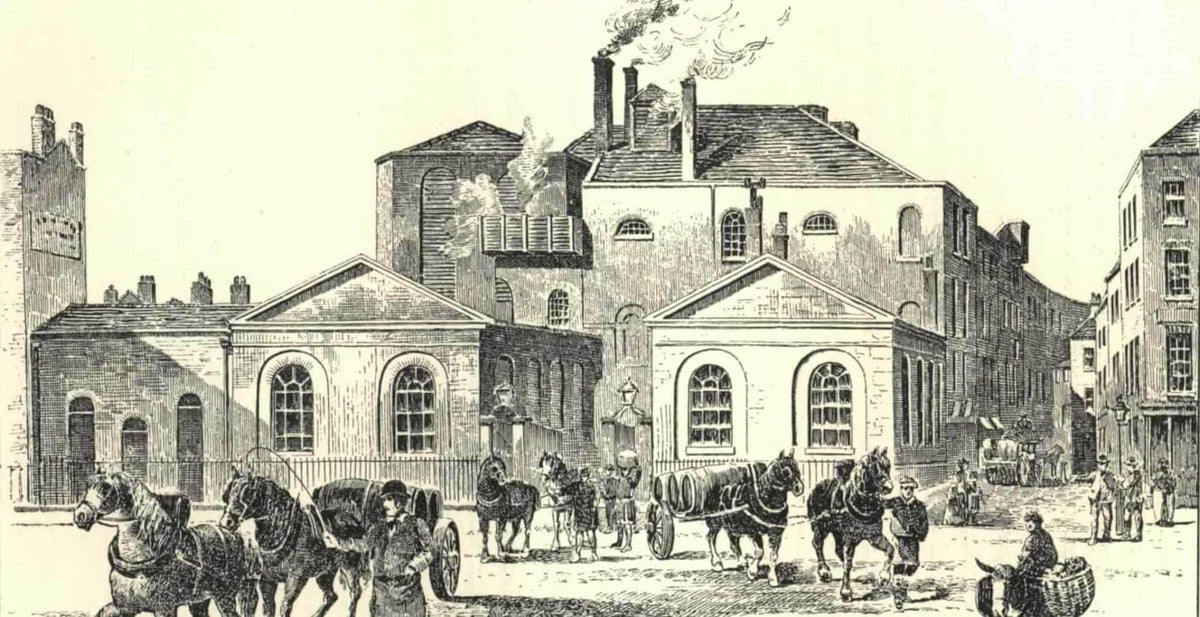
The Horse Shoe Brewery, operated by Henry Meux & Co. near Tottenham Court Road, was one of the major porter producers of its day. It made more than 100,000 barrels a year. Behind its high walls stood the vat that would make the brewery infamous.
October 17, 1814
The hour everything broke loose.
The accident unfolded quickly, but it did not begin without warning.
Around 4:30 p.m.
A hoop slips from the vat
Storehouse clerk George Crick noticed that one of the heavy iron hoops around the great porter vat had failed. Similar problems had happened before, so the damage was recorded for repair rather than treated as an immediate emergency.
Roughly one hour later
The vat ruptures
The wooden vessel burst apart. The force damaged neighboring containers, knocked down part of the brewery wall and released a chain reaction of beer, timber and brick.
Within minutes
Porter surges into St. Giles
The flood raced through narrow streets and into low-lying rooms. With poor drainage and many residents living in cellars, the neighborhood had little protection from the sudden rush of liquid and debris.
The rescue
Neighbors search through ruins
Rescuers waded through beer and pulled apart wreckage by hand, calling for quiet so they could hear people trapped under collapsed walls and roofs.
The human cost
The beer was extraordinary. The tragedy was painfully ordinary.
St. Giles was one of London’s poorest and most crowded districts. That is why a brewery accident became a neighborhood catastrophe.
New Street
Homes became traps
Mary Banfield and her young daughter Hannah were taking tea when the flood struck. Nearby, mourners had gathered in a cellar for the wake of a two-year-old boy. The force of the beer and collapsing buildings killed the people inside.
The Tavistock Arms
A wall came down
Fourteen-year-old Eleanor Cooper was working near the pub when the brewery wall collapsed. She was buried by the debris and killed.
Inside the brewery
Workers survived
Remarkably, the confirmed deaths occurred outside the brewery. Workers escaped or were rescued, while the worst destruction fell on the neighboring homes.
The confirmed record
Eight people died
Later retellings sometimes add a ninth victim who supposedly died after drinking beer from the street. Contemporary support for that story is uncertain, so it should be treated as an unconfirmed legend rather than part of the verified toll.
Myth versus record
The truth is darker than the folklore.
The popular version
Londoners celebrated free beer
Colorful retellings describe crowds scooping porter from the gutter, drinking themselves senseless and treating the flood like an unexpected festival.
The responsible version
A poor neighborhood absorbed an industrial failure
There were reports of people collecting beer, but the best-supported story is one of collapsed buildings, trapped residents, public mourning and families left without compensation. The spectacle should never overshadow the victims.
The inquest called it an “Act of God.”
A jury ruled the deaths accidental and placed no legal blame on the brewery. Meux & Co. did not compensate the victims’ families. The company was later able to recover excise duty already paid on the lost beer, helping it survive the financial blow.
What changed afterward
Brewing grew safer, but not overnight.
The flood belongs to a period when breweries were becoming industrial operations before modern engineering standards, worker protections and product-safety systems had fully caught up.
Scale magnifies risk
A problem that seems routine can become catastrophic when equipment holds thousands of barrels under pressure.
Warnings need action
The fallen hoop had been seen before the rupture. Modern safety culture depends on treating unusual equipment behavior as information, not background noise.
Materials matter
Breweries gradually moved away from gigantic wooden storage vessels toward stronger, more controllable materials and designs.
The Horse Shoe Brewery continued operating for more than a century. It was eventually demolished in the 1920s, and the Dominion Theatre now occupies part of the former site. London moved on, but the flood remained one of beer history’s most haunting cautionary tales.
Bring the history back to the glass
You do not need a three-story vat to explore porter.
The beer in the 1814 flood would not taste exactly like a modern American porter. Ingredients, strength, aging and production methods have all changed. But brewing a porter at home is still a delicious way to connect with the dark beer tradition that once defined London.
Brew a dark, roasty piece of beer history.
Mr. Beer’s American Porter Standard Refill pours dark mahogany with roasted caramel malt character, medium body, mild bitterness and a creamy head. It is a modern, approachable porter—not a museum reconstruction—and a great starting point for tasting why dark beer has held drinkers’ attention for centuries.
Frequently asked questions
The beer flood, explained.
What caused the Great London Beer Flood?
An iron hoop around a huge wooden vat failed. About an hour later the vat ruptured, damaging nearby vessels and part of the brewery wall. The resulting chain reaction released porter into the surrounding streets.
How much beer flooded London?
Frequently cited historical estimates put the total at roughly 320,000 gallons, although exact figures vary among accounts.
How many people died?
Eight deaths are confirmed. Stories about a ninth person dying from alcohol poisoning after drinking beer from the street are not firmly established.
Was the brewery punished?
No. The inquest treated the disaster as an accident or “Act of God,” and the brewery was not held legally responsible for compensating the victims’ families.
Is porter the same as stout?
The styles share history and can overlap, but they are not always identical. Modern brewers generally treat porter and stout as related dark-beer families with a wide range of roasted, chocolate, coffee, caramel and toasted characteristics.
Source notes
History behind the story.
- HISTORY: The London Beer FloodDetailed account of the vat failure, neighborhood damage, eight confirmed victims, inquest and excise-duty relief.
- BBC HistoryExtra: The London Beer Flood of 1814Background on the Horse Shoe Brewery, St. Giles, the estimated 320,000-gallon release and the disaster’s aftermath.
- Historic UK: The London Beer Flood of 1814Additional summary of the brewery, casualties, legal ruling and later changes to large fermentation vessels.
- Mr. Beer: American Porter Standard RefillCurrent product details for the modern homebrewing connection featured above.