

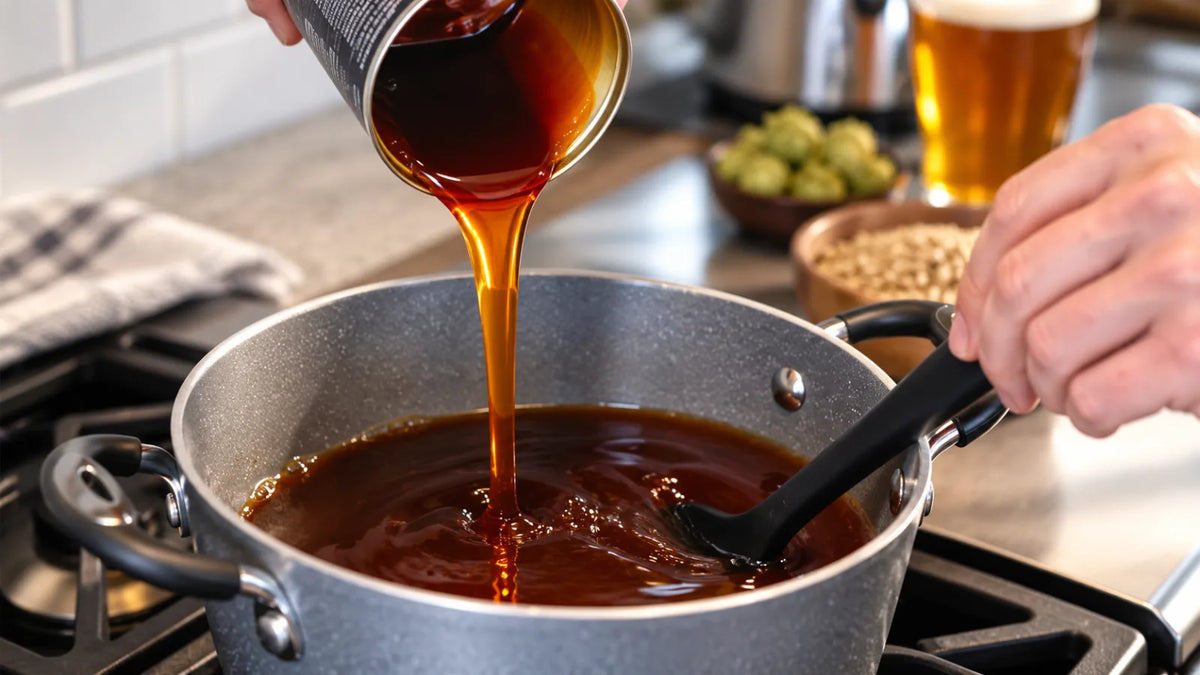
If you are new to Mr. Beer, the can of Hopped Malt Extract may be the most mysterious part of your first batch.
It is thick. It is sticky. It smells strongly of malt. And somehow that one can replaces several steps that can take hours in other forms of homebrewing.
That is because Hopped Malt Extract, or HME, is concentrated wort with the base malt and hop character already built in. A lot of the brewing work has already been done before you ever open the can.
Understanding what HME does makes the Mr. Beer process much easier to understand — and makes it easier to see how you can build more advanced recipes from the same basic system later.
- HME stands for Hopped Malt Extract. It contains concentrated wort with malt and the beer's base hop character already built in.
- Much of the brewing has already been done. You do not need to mash grain or perform a full wort boil for a basic Mr. Beer batch.
- Do not boil Mr. Beer HME. Remove your brewing water from the heat before stirring in the extract.
- HME is the starting point, not the limit. Mr. Beer recipes can build on it with additional malt, hops, grains, yeast, fruit, spices, and other ingredients.
What Is Hopped Malt Extract?
Before beer can ferment, brewers need to make a sugary liquid called wort.
In all-grain brewing, that means crushing malted grain, soaking it at controlled temperatures so its starches become fermentable sugars, separating the liquid from the grain, boiling the wort, and adding hops.
Hopped Malt Extract takes much of that work and does it ahead of time.
Mr. Beer HME starts with malted grain that is mashed to create wort. Hops are added during the brewing process to provide bitterness and flavor. The finished wort is then concentrated by removing much of its water.
The result is the thick syrup you see when you open a Mr. Beer brewing extract can.
If you want to see the production process in more detail, our guide to how Hopped Malt Extract is made walks through it from grain to can.
What Has Already Been Done for You?
This is the easiest way to understand why HME makes homebrewing simpler.
Before that can reaches you, the malt has already been mashed, the wort has already been produced, and the beer's base hop additions have already been made.
That means a basic Mr. Beer batch does not require you to:
- Mash several pounds of grain
- Separate wort from spent grain
- Boil a full batch of wort
- Build a timed bittering-hop schedule
- Rapidly chill a large kettle of hot wort
Instead, you can focus on the parts of brewing every brewer needs to learn: keeping equipment clean and sanitized, following the recipe, pitching yeast at the proper temperature, managing fermentation, bottling, carbonating, and giving the beer time to condition.
That is why HME works so well for beginners. It simplifies brew day without skipping fermentation — the part where yeast actually turns wort into beer.
What Does HME Add to Your Beer?
The HME provides the foundation of the finished beer.
Malt
Malt provides the fermentable sugars that yeast consumes during fermentation. It also contributes much of the beer's color, body, and malt flavor.
Depending on the beer, those flavors might come across as light and grainy, bready, toasty, caramel-like, or more deeply roasted.
Hops
Hops help balance malt sweetness and contribute bitterness, flavor, and aroma.
With HME, the beer's basic hop character has already been established before you begin brewing. Different Mr. Beer extracts are formulated differently, which is one reason a pale lager, amber ale, porter, and IPA do not taste the same even though the basic brewing process is similar.
What Happens When You Brew With HME?
A basic Mr. Beer brew day is intentionally simple.
You sanitize your equipment, prepare your brewing water according to the instructions, remove the pot from the heat, and stir in the Hopped Malt Extract.
That mixture is your wort.
The wort then goes into the sanitized fermenter with the appropriate amount of water. Once it is at the proper temperature, you add the yeast.
From there, yeast takes over.
During fermentation, yeast consumes fermentable sugars from the malt and produces alcohol, carbon dioxide, and flavor compounds. After fermentation is complete, the beer can be bottled, carbonated, conditioned, chilled, and eventually poured into a glass.
A basic 2-gallon Mr. Beer brew day takes about 30 minutes of active time, although recipes with additional grains, hops, fruit, spices, or other steps may take longer.
For the complete beginner process, see our Mr. Beer brewing instructions.
Why Don't You Boil Hopped Malt Extract?
This is one of the most important differences between brewing with Mr. Beer HME and starting from grain or unhopped extract.
The HME has already gone through the brewing and hopping process.
There is no need to boil it again.
For a standard Mr. Beer batch, bring the brewing water to the point directed by your instructions, remove the pot from the heat, and then stir in the HME.
Boiling Hopped Malt Extract again can change the color, bitterness, and flavor that were designed into the extract.
We cover that topic in more detail in Why You Should Not Boil Hopped Malt Extract.
If you are brewing a Mr. Beer recipe that includes additional hops or grains, follow that recipe's instructions. Those extra ingredients may have their own steeping or boiling steps without requiring you to boil the HME itself.
HME vs. LME: What's the Difference?
You may also see another abbreviation in Mr. Beer recipes: LME, or Liquid Malt Extract.
The easiest beginner distinction is this:
| Hopped Malt Extract (HME) | Liquid Malt Extract (LME) | |
|---|---|---|
| Contains malt | Yes | Yes |
| Base hop character included | Yes | No |
| Main role in Mr. Beer recipes | Provides the base of the beer | Adds additional malt character, body, color, and fermentable sugars |
That is why you may see a Mr. Beer recipe start with an HME can and then add LME. The HME provides the hopped beer base, while the additional malt extract helps change the body, flavor, color, or strength of the recipe.
Can You Add More Ingredients to HME?
Absolutely.
One of the advantages of starting with HME is that you can keep your first batch very simple and then add complexity as you get more comfortable brewing.
Mr. Beer recipe kits may build on an HME base with ingredients such as:
- Additional Liquid Malt Extract
- Specialty grains
- Additional hops
- Different yeast strains
- Fruit
- Spices
- Wood or other specialty ingredients
The HME still provides the foundation. The extra ingredients change or expand the flavor of the finished beer.
This gives beginners a useful progression: start with a basic refill, learn the process, and then move into more involved recipes without having to replace the entire brewing system.
Why Batch Size Matters
Each refill or recipe is designed around a specific amount of finished beer.
With Mr. Beer 2-gallon refills, the amount of extract and the target water volume are designed to work together.
Adding significantly more water does not simply give you more of the same beer. It dilutes the malt sugars, color, body, flavor, and bitterness.
For the beer to come out the way the recipe was designed, follow the batch volume listed in the instructions rather than trying to stretch the extract into a larger batch.
HME Makes the First Brew Day Easier — Not Less Real
Hopped Malt Extract sometimes gets described as a shortcut, and technically it is.
But it is a shortcut because the early brewing steps have already been completed for you, not because those steps never happened.
The grain was still malted. The malt was still mashed. Wort was still created. Hops were still added. The wort was simply concentrated so you could pick up the process later at home.
For a new brewer, that means less equipment, fewer opportunities for something to go wrong on the first brew day, and more time to learn the fundamentals that will matter on every batch you make.
And when you are ready to experiment, that same HME can become the base for much more involved recipes.
Ready to Put HME to Work?
Start with a simple refill or explore a recipe that builds additional malt, hops, and flavor onto a Mr. Beer HME base.
Frequently Asked Questions
Does Hopped Malt Extract already contain hops?
Yes. HME has already been brewed with hops, so the beer's base bitterness and hop character are built into the extract. Some recipes add more hops for additional bitterness, flavor, or aroma.
Do I need to boil Mr. Beer HME?
No. For a basic Mr. Beer batch, remove your brewing water from the heat before stirring in the Hopped Malt Extract. The HME has already been through the brewing and hopping process.
What is the difference between HME and LME?
HME contains malt plus the beer's base hop character. LME is unhopped malt extract. In Mr. Beer recipes, LME can be added to an HME base to contribute additional malt flavor, body, color, and fermentable sugars.
Can I add more hops to beer made with HME?
Yes. HME gives you a hopped base, but many Mr. Beer recipes include additional hops to change the bitterness, flavor, or aroma. Follow the instructions for the specific recipe you are brewing.
How much beer does Mr. Beer HME make?
Mr. Beer 2-gallon refills are designed for approximately a 2-gallon batch. Always follow the batch volume listed with your specific refill or recipe rather than adding extra water to stretch the extract.
Is brewing with HME real homebrewing?
Yes. The malt has already been mashed and the wort has already been hopped and concentrated, but you still prepare the wort, pitch the yeast, manage fermentation, package the beer, carbonate it, and condition it at home. HME simply removes several time-consuming steps from brew day.


