

The Brew Times Homebrewing Blog
Beer Braised Carnitas
It’s already February 2022 and Valentine’s Day is fast approaching, so naturally, I am thinking about the things I love… Among those things are beer and carnitas! If you are not from the Southwest, “carnitas” are braised, roasted, and shredded pork spiced with Mexican flavors. You can use that delicious meat to fill tacos, burritos, eat over rice, etc. It’s just delicious. An already delicious recipe becomes even better with the addition of your own homebrew! What you need: 2 dried New Mexico or guajillo chiles 4 pounds skinless, boneless pork shoulder (butt), cut into 2-inch pieces 12 ounces lager (any will do, including Mexican Cerveza) 4 garlic cloves, lightly crushed 4 teaspoons kosher salt How to make it: Toast chiles in a dry large heavy pot over medium heat until slightly puffed and lightly darkened on both sides, about 2 minutes. Remove from pot; let cool. Stem chiles and halve lengthwise, discard seeds. Bring chiles, pork, beer, garlic, salt, and 1 cup water to a boil in the same pot. Reduce heat, cover, and simmer, stirring occasionally, until pork is fork-tender, 60-80 minutes. Uncover pork; simmer until liquid evaporates and pork begins to brown, 20-25 minutes. Continue to cook, stirring frequently and scraping the bottom of the pot, until pork is shredded and browned, 10-15 minutes. Add 1 cup water to pork; cook, scraping up browned bits from the bottom of the pot, for about 1 minute. HOW TO PREPARE AHEAD: Carnitas can be made 3 days ahead. Let cool. Cover and chill. Reheat with 1/2 cup water in a covered pot, adding more water if needed to keep the pork moist. I hope you enjoy this recipe and if you make it, please let us know in the comments how it went for you! Cheers! Ashley
Read moreThe Brew Times Homebrewing Blog
Get to Know the Mr. Beer Hops
Looking to expand your brewing knowledge? Well, we got you covered with everything you need to know about the different styles of hops.
Read moreBrewing with Mr. Beer Saves Water vs. Other Brewing Methods
Homebrewing with Mr. Beer is better for the environment than brewing all-grain due to using less water in the brewing process. Crazy right? Okay, so this is something that we wanted to look into. We don’t just make claims without doing our homework to make sure what we are saying is accurate. Thus, a test was conducted! We wanted to take a look at water usage when homebrewing. Water is a pretty important component of the brewing process, not much can get done without it. You need water to brew beer and you need good water to brew good beer. You just can’t get around it. So, if you wanted to use less water during your brew day to help do your part for water conservation than the best thing you can do is brew with Mr. Beer. We looked at the volume of water need for brewing a batch with a Mr. Beer Refill which is a 2.25-gallon batch and the volume of water needed for brewing a 2.25-gallon all-grain recipe of an equivalent beer. Let’s say a Lager coming in around 5% ABV. Okay so for brewing this batch from all-grain you are going to have to do your mashing and your boil. When brewing with all-grain you lose water to evaporation, so you need to use more at the start. In order to yield 2.25 gallons of wort for your brew, you are going to need to start with 4.25 gallons of water. Not to mention you are also going to spend a few extra hours brewing from all-grain instead of the hour tops when brewing with Mr. Beer. Now let’s look at the Mr. Beer Refill. When using our refills to brew you don’t need to do mashing and boiling. The only water you need is 2.25 gallons. You will mix your can of Malt Extract into this and add your yeast and your good to go. So, brewing with a Mr. Beer Refill cuts the water down that you are using as a homebrewer. 2.25 gallons with Mr. Beer vs. 4.25 gallons with all-grain. That’s about an 88% increase in water usage! That’s Crazy!! If you want to save on water for your brew day then try a Mr. Beer Refill. Brewing with Mr. Beer cuts down on time, helps with consistency, and makes an amazing beer!
Read moreHow to Brew a Low Carb Beer?
As you already know, it is time to ring in the new year and I do not know about the rest of you, but I am happy to wave “bye, bye” to 2020! Along with hopes for a happier year going forward, many beer drinkers and non-beer drinkers alike, take the start of the new year as an opportunity to set resolutions that might help improve their health or even cause them to lose a few pounds. So, the question might be “how does a homebrewer make beer with less of a dietary impact?”. Luckily, that question has an answer, and that answer is “enzymes”. Did you know at Mr. Beer we have recipes that help to easily harness the power of enzymes? More about that later though. What is an enzyme, anyway? To put it broadly and simply, an enzyme is a substance that acts as a catalyst to bring about a specific biochemical reaction. The enzymes that we typically find/use in brewing generally come from the yeast, but they can also be added as a supplement to your wort. You may already be aware that enzymes make the process of the yeast turning sugar into alcohol, possible. Enzymes help to break down carbohydrates, both simple and complex so that the yeast cells can consume and convert them into alcohol. Depending on the Different types and quantities of malt sugars your wort contains, your yeast generally produces enough of its own enzymes during the fermentation process to ferment and convert an acceptable amount of the more complex wort sugars to not only create alcohol but leave enough behind to still maintain a good body, mouthfeel and foam stability. We know that a large majority of malt sugars generally ferment into alcohol… so what happens to those more stubborn carbohydrates that the yeast cannot manage to break down and ferment using its own enzymes? You end up consuming them, and they might end up contributing to some extra “thump in your bump” if you know what I mean. Do not worry though, because we have access to easy to find, easy to use, enzymes. You may be thinking “Great, now I have to track down some fancy brewing enzymes?!” Well, breathe a sigh of relief, because in most cases, you are a couple of “Beano” tablets away from your own “low-carb”, homebrewed beer! Yes, I said Beano…The stuff you take when that extra serving of frijoles threatens to turn you into a human fan-boat… You catch my drift. Believe it or not, Beano contains just the right spectrum of enzymes to rip apart those more complex Carbohydrates and turn them into sugars that can be converted to ethanol; that means you end up consuming fewer carbs and just a little more alcohol. This means you might be able to keep your beer AND your health resolutions… WIN. WIN. The even better news about all this, is my good friend, co-worker, and Brewmaster-Maximus, has already developed 3 recipes using those handy-dandy Beano tablets to get you started. Check them out for yourself. We call them our “Work out” recipes and you can find them here: Search results for: 'workout' | Mr. Beer. Unlike most commercially available low-carb beers, these recipes are full of flavor but still short on unwanted carbohydrates. All of this is made possible by our little drug store enzyme hero, “Beano”. With low-carb diets, all the rage right now, isn’t great to know you could still work your homebrew into them? Even though we have already designed a few low-carb specific recipes, pretty much any of our refills and even some of the regular recipes can have Beano added to them to lower the carbohydrate content! We recommend experimenting to see what results you can get using this method! All this being said, keep in mind that in “normal” beer, the stuff that gives beer “body” and “sweetness” is also the same stuff that your Beano enzymes are dismantling for consumption, so expect a “drier” result. I find this method works especially well to create, those coveted “crispy, dry lagers” that go down “really easy” but try it for yourself and let us know what you get! So now that you know that healthy goals AND homebrew can in-fact exist together, don’t you feel better? I know I do! After all, isn’t it just a little easier to stick with things when you can have a guilt-free treat? The best question now is, “what are you waiting for?”. Head to your medicine cabinet or your local drug store and get yourself some Beano and have a low-carb, brew-bonanza of your own! Happy New Beers! Bottoms up, Brewers! CHEERS!
Read moreGet To Know The Mr. Beer Grains
Looking to expand your brewing knowledge? Well, we got you covered with everything you need to know about the different styles of grains.
Read moreWhat are the different stages of Mr. Beer Recipes?
We did this video a while back, but we have updated our recipe offering and given all the new brewers we thought it was time for a new one. We break our recipes down into 3 categories. Extract Plus, Partial Mash, & Advanced Brewing recipes. Extract Plus – This is a can of hopped malt extract plus simple additional ingredients. This can be fruit, LME, DME, Hops. So it took our base cans and added a few additional ingredients. If you are going to start brewing recipes we would recommend starting with this category. Partial Mash – With these recipes, we are adding additional steeping grains. This is where you will steep some grains for about 30 minutes. Then you will hops or fruit or anything else to your brew and follow the brewing process. Advanced Recipes - This is where we take brewing to the next level. All of these recipes are LME or DME. So this will require longer boil times, usually up to an hour. This is because we are using unhoped extract so to get bitterness you need to boil your hops. You will also need some additional equipment as well.
Read moreWhat is the difference between a standard refill, a deluxe refill, and a craft refill?
We offer 3 different types of refills on the site, standard, deluxe, and craft. We thought it would be helpful to break down the difference in those for easy reference. We offer 10 different standard refills. These refills consist of a can of HME, No-Rinse cleanser, and a booster. The booster is the main difference in those. What this will do is increase the ABV of your beer and the body of the beer without altering the flavor or adding any other off-flavors. You will get 2 packets of the booster with your standard refill. The deluxe refill is also 10 different styles. These are the same base HME cans that are used in the standard refills. With these ones, you get your can of HME, No-Rinse, and 2 packets of LME or liquid malt extract. What these will do is increase the ABV of your beer and add more maltiness to your beer. It also added more flavor and body to the beer as well. Our craft refills come in 5 different styles. These are bigger cans of HME. So the beer they produce has a higher ABV, with more favor and hoppiness. With these, you get the can of HME, No-Rinse, and our Carbonation drops. Cheers, Robert
Read moreHow to pick the right Mr. Beer Kit based on beer style?
Everyone enjoys all kinds of different beers. So I thought it would be helpful to break down how to pick the right beer kit for a person based on what type of beer they drink. Within our beer kits, there are 7 different styles that you can select from. Each one of these will produce a different beer that is a particular style.For the kit styles, we have our American Lager, Long Play IPA, Golden Ale, Bewitched Amber Ale, Northwest Pale Ale, Diablo IPA, or our Bonus kit which is a variety that has our Canadian Blonde & Oktoberfest lager. Now what we are going to attempt to do is based on popular styles or commercial beer pair that with the right style of kit. So to start we will look at the American Lager. If you are a fan or the person you are buying this for, enjoys beers like Sam Adams, Bud Light, Budweiser, Coors, or anything along those lines then this would be the kit style best suited for you. So now for our IPA’s. In this one, I will include our Long Play & our Diablo. Now I do want to note that these are very different IPAs. The Long Play is a much lighter IPA. It is lighter in color and not as bitter as the Diablo. The Diablo is darker and more bitter. Now if you enjoy any IPA or the person you are shopping for does, I would pick the Long Play over the Diablo. It is just a better introduction beer than the Diablo. Now onto our Golden Ale. This beer would be for the person who enjoys blonde-style ales. These are mostly craft-style beers. But they are light in flavor, and not very hoppy. They are well-balanced and easy to drink. Also, if you are unsure what kind of beer the person who you are getting this for drinks, then this would be the best kit to get. It makes a great beer that everyone enjoys. Our Northwest Pale Ale is going to be for those who enjoy beers like Sierra Nevada Pale Ale. Or any other pale for that manner. This is a lighter beer style with mild bitterness. So more bitterness than our Golden Ale or Lager but less than our IPAs. Our Bewitched Amber ale is an interesting beer. It is a darker beer with more malty flavors. The most popular Amber Ale is Fat Tire. This beer is similar to that, but I think maltier and has less hop flavor. Lastly, our Bonus Kit has our Canadian Blonde & Oktoberfest. These are two baseline styles that anyone can enjoy. This is also another kit if you are unsure of what to get grab this one. Cheers, Robert
Read moreWhat is the difference between HME & LME?
If you have been brewing with Mr. Beer or any other homebrewing company you may know about malt extract. But there are 2 different kinds of liquid malt extract. First, let's talk about similarities, both of these are condensed forms of wort. This is done through evaporation to extract moisture and create a syrup-like substance. That’s about where it ends. One thing to note is that not all liquid malt extract is created equally. One thing about the Mr. Beer extracts is that we use low-temperature processed evaporation. What this does is helps preserve the integrity of the malt extract. Now for the differences. The main difference is that one is hopped and one is not. So Liquid Malt Extract does not have any hops added to it. So that means that you need to do a hop boil to get any bitterness in your beer. Hopped malt extract is pre hopped, so all you have to do is dilute it with water, and you are good to go. Brewing with hopped malt extract is much simpler. Brewing with LME allows you more customization over the process. All of Mr. Beer’s Refills use HME. When you get into our recipes we use a mixture of LME & HME. With our advanced recipes, those are all LME based. Cheers, Robert
Read more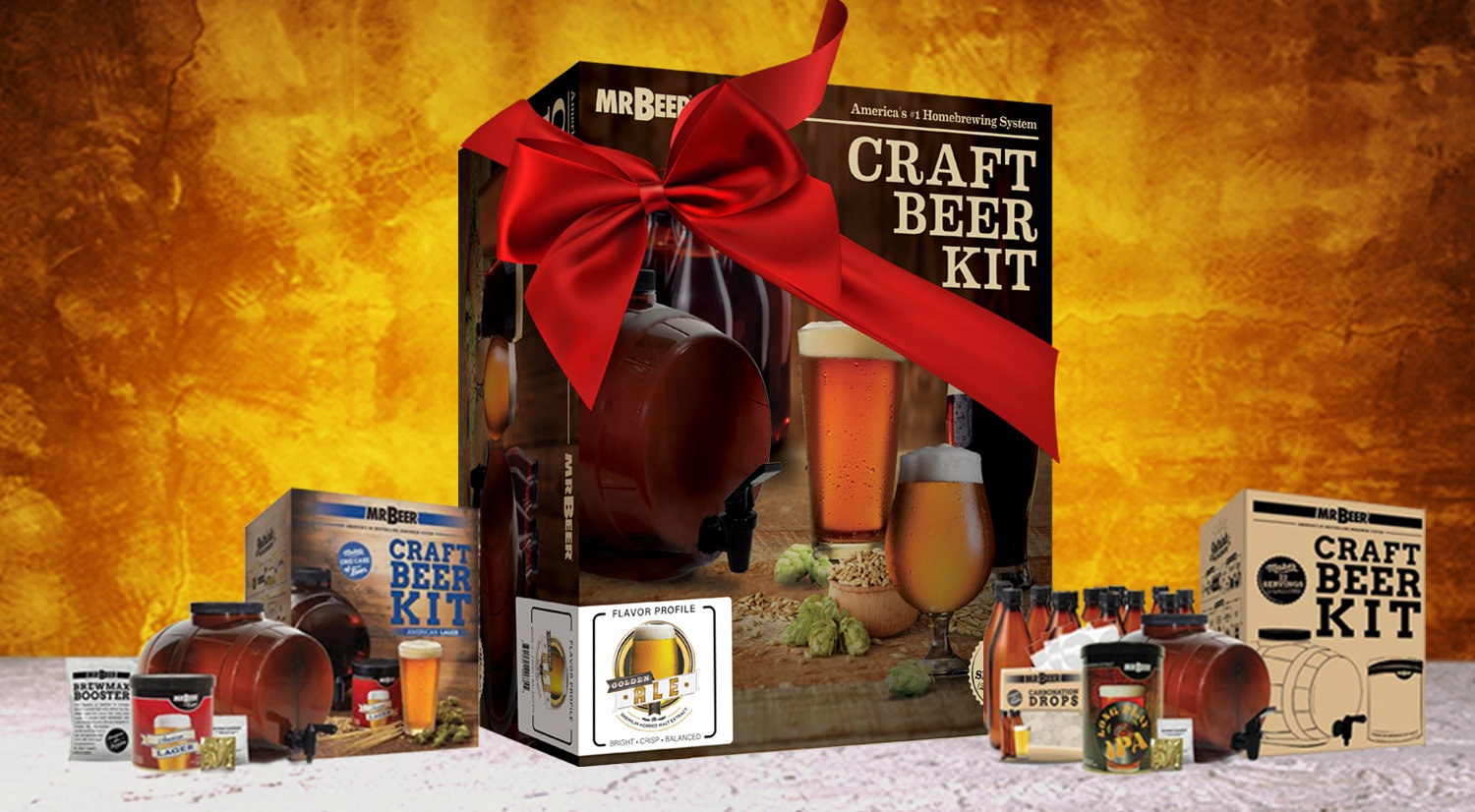
Gift Guide to Selecting the right Mr. Beer Kit for the soon to be brewer in your life.
As the holidays come near you must be wondering what to get that person who has everything? It's hard to find that perfect gift that is not boring and not the same old stuff. Instead of thinking of all the mundane gifts, think of something cool and exciting! If the person your shopping for likes beer, like really likes beer, then get him a Mr. Beer Kit! As Cousin Eddie would say, “Clark, that’s the gift that keeps on giving the whole year”. The great thing about a Mr. Beer Kit is, it’s simple to use and you don’t need to get anything else. As long as you have some common kitchen items, can follow the easy step by step instructions, and work a can opener you should be good to go. We offer two main types of Kits, our Starter Kit’s and our Complete Kits. The Starter Kits will come with our 2-Gallon Fermenter, a Mr. Beer Refill, and our No-Rinse Cleanser. Everything he needs to get started brewing. The Complete Kit’s will come with everything included in the Starter Kit’s, but it will also include Bottles & Caps and our amazing Mr. Beer Carbonation Drops which make bottling ridiculously easy. Our Starter Kit’s and Complete Kit’s come in 6 different flavors. We have our American Lager Kits which are great for those who enjoy light beer. Similar to Budweiser, Bud Light, Sam Adams Boston Lager, or just any light American style lager. The next most popular style is our IPA Kits. We offer 2 different types of IPA’s. Our Long Play IPA is going to be a light color west coast IPA, very similar to the IPA’s you find in a lot of local craft breweries. The other IPA is our Diablo IPA. This beer is going to be more of amber or reddish color with all kinds of hop flavor. These kits are great for those who love the extremely hoppy beers. Our Northwest Pale Ale Kits perfect for anyone who likes Sierra Nevada’s Pale Ale or any beer that is light in color with a mild hop flavor. If your buying this for someone who is into craft beer this would be a great kit for them as the Pale Ale styles is a staple in most breweries. We have our Bewitched Amber Ale which is a smooth beer that is perfectly balanced in flavor. An ideal kit for someone who is not a fan of lighter beers and enjoys something more flavorful. The great thing about all our Mr. Beer Kits is that they are reusable. The only thing that would be needed to brew again would be a Mr. Beer Refill or to choose from over 100 Mr. Beer Recipes. If you're looking to get a kit, and an extra brew to keep the beer flowing for a little while we recommend getting a second Refill before moving on the Recipes. (If you want to learn what a Mr. Beer Refill is, check out our What is a Mr. Beer Refill Video Blog.) Just remember, no matter what Mr. Beer Kit you get, the receiver of your awesome gift, will be forever grateful that you introduced them to homebrewing and did not get him a year subscription to the jelly of the month club.
Read moreWhy You Should Brew With Mr. Beer?
I choose to brew with Hopped Malt Extract (HME) from Mr. Beer so I can brew a batch in 30 minutes and do everything else I want to do. I don’t want to waste an entire day brewing a batch of beer. There are other things I would rather do than watch a pot boil for 8 hours. By using HME as a base I can easily experiment with other ingredients to make any kind of crazy beer I can think of in a short amount of time. Here at Mr. Beer, we have 16 different base styles you can brew from, then building off of those 16, we have created over 100 different recipes which we constantly rotate. We use hops, grains, DME, fruit, soda, heck even bacon. Since we are using the HME as a base it shortens the brew day and allows us to get very creative with our recipes. There are 6 key reasons why I think you should brew with Mr. Beer. They mean a heck of a lot to me, so I hope they mean something to you too. Saves TimeIt reduces brew day from 4-8 hours down to 30 minutes. Even the most complex recipes will take from 1 to 1.5 hours tops from set-up to clean-up. You will have time to enjoy the important things in your life. Who wants to spend an entire day watching the pot boil? Saves SpaceThe Mr. Beer Kit is compact. We use a 2-gallon fermenter that does not take up much space.. All you need to brew are a few common kitchen items. No extra pots, tubes, strainers, buckets, or anything else. I don’t know about you, but I don’t have the space to have my garage taken with a bunch of brewing equipment. Saves MoneyYou can save $600 a year at a minimum. To get started with Mr. Beer all you need is one of our 2-Gallon Beer Making Kits. They cost between $39-$59 depending on what you get. Other homebrewing kits can range from $39-$49 for 1 gallon of beer or $125+ to brew all-grain, but you will still need additional items besides just the starter kit so it’s a little closer to $200. Let's break it down. The cost per beer, for a Mr. Beer Kit at $59.99 will cost you $2.50 a beer for your kit. For a 1 Gallon Kit at $39.99 it will cost you $4 a beer, and for the all-grain kit at $200 it will cost you $3.33 a beer. The best value to brew and save money is clearly Mr. Beer. ConsistencyI went over the basic brewing process earlier. A lot of the boiling involved with each of the processes requires you to hold the boil at certain temperature range for a specific period of time. If you don’t, you can mess up your beer and can get some off-flavors or beer that isn’t what you wanted. When brewing with Mr. Beer you don’t have to worry about that. Using our HME takes out those variables so you can get a more consistent beer every time you brew. We have all had that one experience when a friend you know is just hyping up this restaurant. You decide to give it a try after days of anticipation from hearing how good it is. Then that 1st bite of food is just terrible. Well, brewing with Mr. Beer can help prevent that in your beer. Each beer will live up to the hype. Customer SupportI am extremely proud of the customer support we offer at Mr. Beer. Not only are we the best support for a homebrewing company, I think we offer the best support of any company. We have experienced Brewmasters that are very passionate about homebrewing. You can give them a call any time Monday through Friday. We offer live chat and an awesome Facebook group, Mr. Beer’s Brewing Society, where you can learn all kinds of new things about homebrewing. If you have any issues, we take care of it. You have a damaged shipment? We send you a new one. Bad beer? We’ll send you a new batch. Just got some brewing questions? We got you covered. We welcome you as a part of the Mr. Beer family. We don’t have customers, we have brewing partners, friends, and family. The Only Homebrew Company Owned by a BreweryMr. Beer is owned by Coopers Brewery in Australia. Coopers is the oldest family-owned and independent brewery in Australia and they have been brewing beer for over 150 years. They have been in the homebrewing space since the 1970s and create the highest quality malt extract in the world. Coopers creates all of our Mr. Beer Hopped Malt Extracts. This makes Mr. Beer the only homebrewing company whose ingredients are created by a brewery. The same ingredients you use to brew are used to make beer in the brewery. They use state-of-the-art technology and oversee the entire process from “grain to glass.” Coopers is also extremely focused on sustainability. The water they use comes from below the water table and runs through a reverse osmosis process that removes the high salt content. They have an onsite powerplant so that they don’t rely on the local grid. All water, steam heat, grains, etc. is recirculated throughout the brewery and used in more ways than one. Cheers, Robert
Read more5 Reasons Why You Should Homebrew?
Save Money I’m a huge fan of IPA’s. They are the best beers, hands down. Try to prove me wrong, I dare you. However, they can be quite expensive. One of my favorite IPA’s is from a local craft brewery here in Arizona. It runs right around $14-$16 for a 4 pack. That’s insane! It’s like $4.00+ a beer. I get it, they are making “craft beer” but, come on, that’s just too much. Now if you wanted to brew an amazing IPA, let’s say with Mr. Beer, for instance, that same type of beer would cost around $1.05 a beer. That’s it! You’re saving serious cash. Even if you wanted to brew the most expensive IPA that Mr. Beer offers, which is a crazy supper hopped imperial IPA, it would cost about $2.90 a beer. If you're like me who drinks about 6 beers a weekend, at $4 a beer that’s $24 a week, $96 a month, or $1,152 a year. Now if you homebrew and drink 6 beers a weekend at an average of $1.90 that is $11.40 a weekend, $45.60 a month, or $547.20 a year. So, you can save $600 a year by homebrewing! The more you drink the more you save. That’s what I call a win, win! Know Your Ingredients Like many of us, I am cautious about what goes into my body. Our world is full of over-processed foods and drinks and who knows what the ingredients are? Most of the time I can’t even pronounce half the stuff on the back of the labels. You will notice that with beer most brewers don’t list what they use in their beers. Some of them add clarifying chemicals to make the beer look clear or stabilizers to extend the shelf life of the beer. That’s just not cool. With homebrewing, you know exactly what you are putting into your beer, so you can trust that you have the best, real ingredients to brew with. Mr. Beer ingredients are made from all-natural Malted Barley, Hops, Water, and then Yeast (which you add) and that’s all! We use the best ingredients possible and oversee the entire process from the grain fields to the ingredients that go into your beer kit. We want to ensure that you get the best possible beer each and every time you brew. Create Your Own Brew Just brewing your own beer is an extremely rewarding feeling but creating your own custom recipe that is all your own is an experience unto itself. Through some trial and error, you can create some amazing beer. I remember the first recipe I created. I wanted it to be this super hoppy IPA. So, I got all kinds of random hops and threw them together and the result was not that good. I went straight mad scientist and did zero research before I brewed it, I just winged it. Now my second attempt at this was excellent. I did a little research and picked some bittering hops that would pair well together, did a nice 45-minute boil with around 2 oz. of hops and the results were amazing. I think I shared that beer with anyone that was willing to taste it and all were blown away at how well it came out. It's quite a rewarding experience creating your own beer that tastes good and that people truly enjoy. Have Fun Brewing beer is always a good time. You have some friends over, turn on some tunes, drink some beers, and just brew away. It’s the perfect escape from the weekly grind and a great way to relax and unwind. Another fun aspect of homebrewing that is not talked about that much is brewing beer for special occasions, like birthdays, holidays, weddings, etc. I got married 7 years ago and I wanted to brew beer for the wedding, so I brewed 20 gallons of beer, (we like to drink). I still remember what I brewed, it was an American Lager, Pilsner, an Amber Ale, and an IPA. During the wedding reception everyone I talked to did not say the ceremony was great or the flowers or any of that, they all wanted to talk about the homebrew. Every single person mentioned how much they enjoyed the beer. Even in our wedding video, every single comment was “Congratulations, we wish you all the best… And Amazing beer”. It was something that I will never forget. The impact that a good homemade beer can have. To this day when I see extended family members they still talk about the beers I brewed and are always wanting to try something new. Appreciate Good Beer Within the Craft Brewing scene and even Homebrewing you can find a lot of beer snobbery. People like beers a certain way and I get that. I have also come to appreciate a beer that is brewed very well, but I am by no means a beer snob. For the longest time, my go-to beer was Bud Light or Bud Light Lime. Overtime my pallet has changed where I can appreciate a really good brewed craft beer. The more you learn about a subject the more you appreciate the work that goes into it. So, you can tell when you have a good beer and a really good beer. Now, don’t get me wrong, I’ll still grab a Bud Light here and there. One thing that you have to appreciate about the big brewers is that no matter where you are the beer will always taste the same. Once you understand homebrewing you will know how hard that is. Most Craft Brewers have trouble replicating the same exact beer each time. So, I would say that your appreciation for good beer will increase but your appreciation for just beer, in general, will also increase when you learn about all that goes into making a great tasting beer.
Read moreBeer Gravy
Last year, around this time, I brought you a recipe for “Beer Brinded Turkey” This year, I couldn’t help but think I was missing a piece of the puzzle, and then it occurred to me, “THAT TURKEY NEEDS GRAVY!” Not only does the turkey need gravy, but it needs BEER GRAVY, specifically. The beer isn’t even the “best” part of this recipe, it’s also super simple to make too! What’s not to love? So, without further delay, let’s make some gravy (and put it on everything). Ingredients: 4 TBSP of butter ¼ cup AP flour 1 yellow onion minced 2 Garlic cloves minced 2 cups chicken/beef or turkey stock 2 cups of dark beer (porter, stout, or brown ale) Salt and pepper to taste How to make it: In a saucepan over medium-high heat and melt the butter. Once the butter is melted whisk in the flour, stirring constantly until smooth. Add onion and garlic, cook until soft. Next, add in the stock and the beer and then bring the mixture to a boil, whisking constantly until thickened. This should take about 5-6 minutes. Remove the gravy from the heat and season with salt and pepper to taste. And there you have it folks, a delicious and easy beer spiked gravy! I hope you enjoy this recipe and if you make it, please let us know in the comments!
Read more